While it’s easy for businesses to talk about being involved in their local communities, what does it really mean and how does it really look? At Davis, we are truly invested in supporting people in the communities we live and work in.
Funeral homes have traditionally been places people engage with only when absolutely necessary, our mission is bigger than that. We believe that being active in the communities that we serve, can help enrich, and in some cases, improve people’s quality of life. When we say we care for our communities, we mean all the time, not just when families within them need our services.
Davis have been sponsors of Auckland Philharmonia for 14 years as of 2026. As Gold Partners we have been presenters of the In Your Neighbourhood concerts, helping bring the orchestra into communities across Auckland so people can enjoy beautiful live music closer to home. More recently we are also supporting a wonderful new initiative, Morning Music. This series of three concerts is held at the Auckland Town Hall at 11.30am and has been designed especially for those who may no longer feel comfortable attending full-length evening performances. It offers the opportunity to still experience exceptional music in the magnificent Town Hall, but at a time and pace that feels more welcoming and accessible.
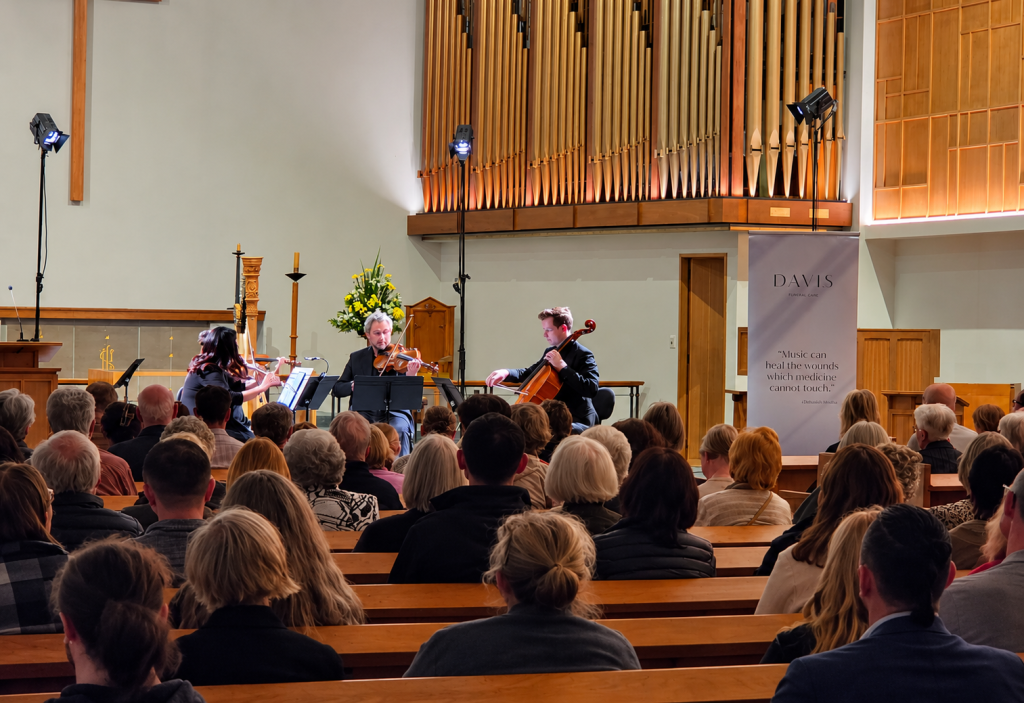
Recently we were part of the Life, Death and the Music Between, legacy planning event. Held at Eden Gardens, a panel of industry experts, Davis Funeral Care General Manager Mike Powell, Tanya Osborne – Craigs Investment Partners Advisor, Robert Clark – Simpson Western Consultant, Property and Trust Law Specialist, Maike Blackman – Mercy Hospice Philanthropy and Corporate Engagement Manager all spoke to attendees about various future planning topics, interspersed with fitting musical pieces played by the Auckland Philharmonia String Quartet.
The first piece being Mendelssohn’s String Quartet No.6 in F Minor, Op.80 – III. Adagio ”Requiem for Fanny” Mendelssohn was 38 when he died, and though he was generally meticulous in his affairs he died intestate, meaning his widow was left to not only raise their 5 children but trying to curate his works. Because of the toll this all it took on her she died six years later leaving many of Mendelssohn’s works remained unpublished for 100 years.
The second piece, Bach’s The Art of the Fugue, was left unfinished when he died. Bach, also had no plans in place. An inventory drawn up a few months after Bach’s death shows that his estate included five harpsichords, two lute-harpsichords, three violins, three violas, two cellos, a viola da gamba, a lute, and a spinet. His music was not regarded as having sufficient material value to be recorded. His estate was divided between his widow, Anna Magdalena, and his nine surviving children. The modest sum did not go far, and his wife died in abject poverty, as did his eldest daughter.
The evening provided valuable and thought-provoking information for the 60 people that attended.